
We
will begin our visit with three Warrior cultures in reverse order and get a
glimpse into a single attribute valued by all Warrior cultures, everywhere.
All
three of our chosen Warrior stand-ins valued the attribute but each had a different
way of reaching/developing the valued ability.
Our
reverse order allows us to ascend the ladder of effectiveness/efficiency, that
is, to develop an appreciation for the attribute and to see how each culture
sought to deliberately develop and hone the razor-sharpening of it.
Only
one of the methods allows, to my eye, a concrete fast track to development, but
the sojourn with each Warrior culture acts as a bolster to this preferred
method.
The Continental Soldier: Coup
D’Oeil
Coup D’Oeil is the French correlate of our attribute. It
translates literally to “stroke of the eye.”
It
refers to the ability to sum and assess tactical situations with a mere glance
or glimpse.
Its
most famous iteration comes from the lips of Napoleon: “There is a
gift of being able to see at a glance the possibilities offered by the terrain…One
can call it the coup d’oeil and it is
inborn in great generals.”
Continental
military minds from de Folard to Hart, from von Clausewitz to Montgomery all felt
that the supreme tacticians possessed coup d’oeil.
All
also felt to varying degrees, with Napoleon, that it was a skill that was
somewhat inborn, but it could be developed a bit by scrupulous study of
terrain, battle topography, and an intimate familiarity with how table-top classroom
tactics seldom translate to real-world contingencies.
So,
we have a highly valued trait, this “stroke of the eye” assessment ability that
is, to the continental view, “You either got it, or ya don’t.”

The Samurai: The Inscrutable Sword
Samurai
battle philosophy/science also valued coup d’oeil but in this warrior culture the skill translates
generally to the concept of the inscrutable sword.
An
inscrutable sword is an opponent, tactic, intention that cannot be read prior
to action. An inscrutable sword is not detected or predicted forward by a
“stroke of the eye.”
An
inscrutable sword is just as problematic to a military mind as the paper tactician
who mistakes the paper map for the field, where a simple fact of widening
contour lines can spell life or death for maneuvering.
In
samurai thought the elite warrior wishes to move from seeing an inscrutable
sword to a revealed sword, a sword that’s intentions can be read via all: eyes,
foot positioning, degree of bend in the elbow, which fingers have blanched
white due to grip choice on the sword hilt, etc.
The
novice warrior does not even think to inventory such minutia.
The
wannabe warrior spends so much time in “trying” to take it all in, the moment
for action is gone—perhaps resulting in one’s own death.
The
elite warrior takes it all-in, again, coupd’oeil.
Same
concept as the continental soldier but here the Samurai offers an insight into how to develop the skill.
“Where
the mind goes, the body goes; the body follows the mind.”
This
simple phrase from Yagyu Munenori’s samurai classic The Book of Family Traditions offers us a bit of
insight to this method.
“Where the
mind goes, the body goes; the body follows the mind,” is often interpreted
as “Our
opponent will betray his intentions via his mind; if we read his body well, we
shall find our opportunity.”
There
is a wee bit of truth in that, but it forgets that the world of combat is full
of feints, fakes, re-directs, obfuscations.
To
Munenori “Where the mind goes, the body goes; the body follows the mind,” refers to Our Own
Mind, Our Own Body—Not that of the Opponent.
Our
skill in coup d’oeil increases because we place all intent in the attention with ZERO
distraction or abstraction.
No
inward cogitation.
Munenori
goes on to express the difference between a novice seeing and a Warrior SEEING.
“The
reflection of the moon on the water is an instantaneous phenomenon. Even though
it is way out in space, the moon casts its reflection in water the instant
clouds disappear. The reflection doesn't descend from the sky in a gradual way,
but is cast at once, before you can blink an eye. This is a simile for the way
things reflect in people's minds as immediately as the moon reflects in a body
of water.”
The
Warrior’s training is directed towards the killing of all distractions,
assumptions, tactical planning etc.
These
are the “clouds” referred to in the text. We must see at the “stroke of an
eye.”
The
samurai obviously sees coup d’oeil as a skill that can be developed more than the
continental soldier.
The
method of training is a twin track of hours of martial training and a like
number of hours of non-ornamental zazen. [Samurai Zen is distinctly a different
animal from the Zen popularized by Suzuki and others.]
If
such a skill is to be developed, time must be spent.
The
samurai give us hope but, still the prescribed method is a bit esoteric and
calls for time.
But
then again, all things do.
The
Question to Ask: Is There a Simpler Way?
Which
brings us to…
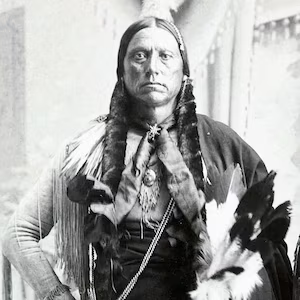
The Comanche Warrior: Tabe
Nanika
Tabe Nanika translates to “Hears the Sunrise.”
It
is an exquisitely lovely phrase—poetically redolent that belies its Warrior
origins.
When
one thinks of a sunrise, we typically envision [literally] with the visual
mode. We think colors, and brightening, and angled shadows.
Tabe Nanika reminds us that each sunrise is accompanied by sound
as well. The gradual music box of bird song as each species chimes in with its
own voice at different times according to how that species reads sunlight
distribution and temperature.
Though
it refers to a visual element with an auditory component, Tabe Nanika is also meant to embody all the senses. We are
called to smell the sunrise as dew on a sunrise may awaken the scent of
petrichor in the soil as it moistens and warms. We may taste the dry tang of
pollen as flowers awaken their “eyes” from a night of slumber.
We
may feel the stirring of our arm hairs as the warming sun begins the tidal
atmospheric waves of air that tell our day.
To
the Comanche Warrior, coup d’oeil is not a gift of “Ya got it or ya don’t.”
It
is also not a sit in meditation and ponder and hope it will manifest itself
when you need it.
No,
Tabe
Nanika
is an active skill that can be relatively easy to acquire via daily practice—this
daily practice termed Suakhet’u is pragmatic and concrete.
It
is not achieved via inward journeys—it is all outward sensory awakening that
asks the Warrior in a gentle Suakhet’u Session to see, hear, smell, touch, taste, feel all.
It
asks the Warrior to hear the sunrise and then rise from Suakhet’u and bring that mere
8-minutes of Sensorium Opening practice forward into the day.
Coup d’oeil is easily achievable.
We
can remove “clouds” from our minds with no need of similes or metaphors.
We
can simply follow an efficient and effective Warrior discipline and acquire
what so many Warriors valued and vaunted.
For
more information on The Suakhet’u Program.
Resources for Livin’ the
Warrior Life, Not Just Readin’ About It
The Rough ‘n’ Tumble Raconteur Podcast

Comments
Post a Comment