Warrior Conditioning Challenge by Mark Hatmaker


If you don't know where you are going, any path will take you there, but you must take a journey to be somewhere.”-Sioux Proverb


Braver are many in word than in deed.”-Grettir’s saga


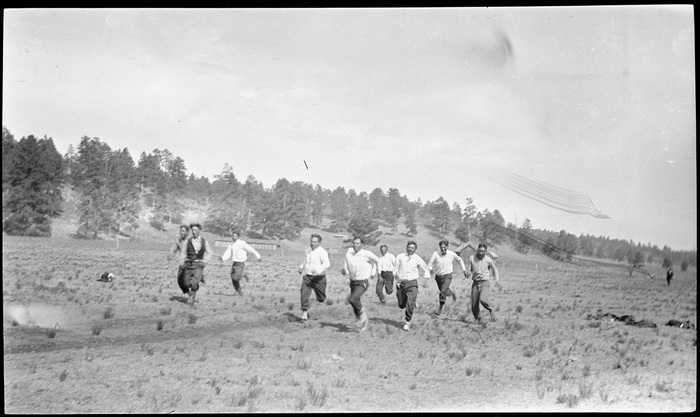
Apache Run

  • Take a big gulp of water.
  • Run 2 miles without swallowing or spitting it out.
  • At the conclusion of the run spit it out and be grateful for your fortitude.
  • If you spit it out or swallow it before the 2 miles are completed—complete your run, then perform 75 burpees, and resolve to better another day.

War-Hammer Run

  • Grab a sledge-hammer or battle-ax if you are lucky enough to possess one.
  • Go for a 2-mile run, preferably where a berserker brandishing a battle-axe will not induce alarm.
  • Extra Credit if you occasionally swing the hammer/axe, yell and gnash your teeth like a bloodthirsty marauder.


T’zat notsowit’u ne’a ekasahpana!” [“Be strong my warriors!”]


Comments

  1. Running with objects changes the game! Started doing it from time to time ever since your challenge to run a mile while rear naked choking a medicine ball -- which is pure misery. My club's last workout of the week (link below) included an 8 minute tire run. Next we'll try the Apache run.

    https://remitchelljr.com/2017/11/04/nasty-nasty-workout-of-the-week-79/

    ReplyDelete
  2. Excellent work! Digging deep is where we grow.

    ReplyDelete
  3. One of the best movies I've ever seen. Hardy and Edgarton are phenomenal. Nick Nolte's performance was astounding as well. I teared up a few times, and the juxtaposition of the the National songs was brilliant. Definitely recommend this movie to anyone who is a fan of... movies.
    zmovie
    123 movies

    ReplyDelete

Post a Comment

Popular posts from this blog

Apache Running by Mark Hatmaker

Of the many Native American tribes of the southwest United States and Mexico the various bands of Apache carry a reputation for fierceness, resourcefulness, and an almost superhuman stamina. The name “Apache” is perhaps a misnomer as it refers to several different tribes that are loosely and collectively referred to as Apache, which is actually a variant of a Zuni word Apachu that this pueblo tribe applied to the collective bands. Apachu in Zuni translates roughly to “enemy” which is a telling detail that shines a light on the warrior nature of these collective tribes.             Among the various Apache tribes you will find the Kiowa, Mescalero, Jicarilla, Chiricahua (or “Cherry-Cows” as early Texas settlers called them), and the Lipan. These bands sustained themselves by conducting raids on the various settled pueblo tribes, Mexican villages, and the encroaching American settlers. These American settlers were often immig...

A Conversation with Neil Melanson by Mark Hatmaker

Here is a chat I had with a good man with a good mind, Neil Melanson. If you are unfamiliar with Neil’s exemplary work he has coached at Xtreme Couture, Alliance MMA, and a HC with the Blackzilians. He is now at gym Genesis Training Academy and Coach of the Filthy Few MMA team. -DVDs out are: Head Hunter, Catchwrestling, and Ground Marshal guard basics  -book Mastering Triangle Chokes -black belt under Karo Parisyan in the Hayastan Grappling System  First things first, Brother Neil, thanks for taking the time to have this chat. Allow me to get another thing out of the way, your book Mastering Triangle Chokes , top-notch. This is high-speed, low-drag stuff all the way. Often there is chaff to be culled through, but you have a linear approach that appeals to the pragmatic streak in me. Excellent work. Thanks a lot man.  You are a real articulate and detailed coach so that means a lot coming from you. Your approach to grappling appeals to my expansiv...

Walk Like a Warrior by Mark Hatmaker

In reading contemporary historical accounts written by soldiers (cavalry and dragoon), settlers, scouts, pioneers, and other citizens of the American frontier 1680s-1880s, I find mention that Native Americans (“Indians” or “Savages” in the accounts) did not walk like “white men.” Their gait, stride, and foot placement is described often in poetic terms as “light” or “light-footed,” “fleet”, “gliding”, and often times “springy” or “spring-like.” These terms while descriptive of the effect do little to tell us the how or why of the gait. We can find clues in accounts given by trackers in any of the myriad “Indian Wars” or skirmishes that riddled the continent in the first few centuries of the settling of the nation. The obvious telltale barefoot or soft impression of a moccasin is often a giveaway that you have a Native American track but this is less so in the moccasined foot as more and more Anglo backwoodsmen adopted this footwear. But there are a few accounts that mention ...