The “Switch” Attack: circa. 1820-1933 by Mark Hatmaker


The newest volume [#35] of The Black Box Project covers a tremendously useful attack called Switching or “Switching ‘em up” among various other names.

It IS NOT the grappler’s switch—a formidable weapon itself with myriad applications and variations.

This volume is ALL striking, ALL on the feet.

We begin with the elements that comprise all switch attacks that contribute to making it a go-to for

·        A significant increase in power via the Power Bump.

·        A contralateral Speed Enhancer.

·        A force multiplier via the Forced Collison

·        A beautiful “Ambush” for ring or street.

We take a historical walk through the different applications of the tactic from roughly 1820 through approximately 1933.

·        Covered are 4 Ring-Legal Applications.

·        6 Empty-Hand Rough ‘n’ Tumble Applications [Some from the early Street Dentist tradition.]

·        2 more “Connected” variations for the street.

·        2 Knife-Fighting specific applications + 1 more for Straight Razor.

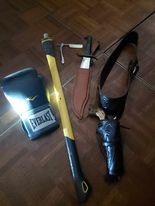
·        3 Saloonkeeper Specials using an ax-handle, cudgel, tire iron, hell, whatever is at your disposal.

·        And 3 Close-Quarters Firearm/Gunfighter applications. I will demo with my beloved six-guns how it was originally done, but your carry of choice will work just fine.

To snag your copy for the August discount price click here.

To learn more about this whole Black Box Project Historical Mayhem Brotherhood and save yourself some moolah, well, have a look-see here: The Black Box Project Lowdown

To hear my dulcet voice drone on about historical mayhem, try our podcast

Mark Hatmaker Rough ‘n’ Tumble Raconteur

Comments

Popular posts from this blog

Apache Running by Mark Hatmaker

Of the many Native American tribes of the southwest United States and Mexico the various bands of Apache carry a reputation for fierceness, resourcefulness, and an almost superhuman stamina. The name “Apache” is perhaps a misnomer as it refers to several different tribes that are loosely and collectively referred to as Apache, which is actually a variant of a Zuni word Apachu that this pueblo tribe applied to the collective bands. Apachu in Zuni translates roughly to “enemy” which is a telling detail that shines a light on the warrior nature of these collective tribes.             Among the various Apache tribes you will find the Kiowa, Mescalero, Jicarilla, Chiricahua (or “Cherry-Cows” as early Texas settlers called them), and the Lipan. These bands sustained themselves by conducting raids on the various settled pueblo tribes, Mexican villages, and the encroaching American settlers. These American settlers were often immig...

A Conversation with Neil Melanson by Mark Hatmaker

Here is a chat I had with a good man with a good mind, Neil Melanson. If you are unfamiliar with Neil’s exemplary work he has coached at Xtreme Couture, Alliance MMA, and a HC with the Blackzilians. He is now at gym Genesis Training Academy and Coach of the Filthy Few MMA team. -DVDs out are: Head Hunter, Catchwrestling, and Ground Marshal guard basics  -book Mastering Triangle Chokes -black belt under Karo Parisyan in the Hayastan Grappling System  First things first, Brother Neil, thanks for taking the time to have this chat. Allow me to get another thing out of the way, your book Mastering Triangle Chokes , top-notch. This is high-speed, low-drag stuff all the way. Often there is chaff to be culled through, but you have a linear approach that appeals to the pragmatic streak in me. Excellent work. Thanks a lot man.  You are a real articulate and detailed coach so that means a lot coming from you. Your approach to grappling appeals to my expansiv...

Walk Like a Warrior by Mark Hatmaker

In reading contemporary historical accounts written by soldiers (cavalry and dragoon), settlers, scouts, pioneers, and other citizens of the American frontier 1680s-1880s, I find mention that Native Americans (“Indians” or “Savages” in the accounts) did not walk like “white men.” Their gait, stride, and foot placement is described often in poetic terms as “light” or “light-footed,” “fleet”, “gliding”, and often times “springy” or “spring-like.” These terms while descriptive of the effect do little to tell us the how or why of the gait. We can find clues in accounts given by trackers in any of the myriad “Indian Wars” or skirmishes that riddled the continent in the first few centuries of the settling of the nation. The obvious telltale barefoot or soft impression of a moccasin is often a giveaway that you have a Native American track but this is less so in the moccasined foot as more and more Anglo backwoodsmen adopted this footwear. But there are a few accounts that mention ...